Social Media Kills
Written by: Samyukta Vivek
Edited by: Ameya Vathanan
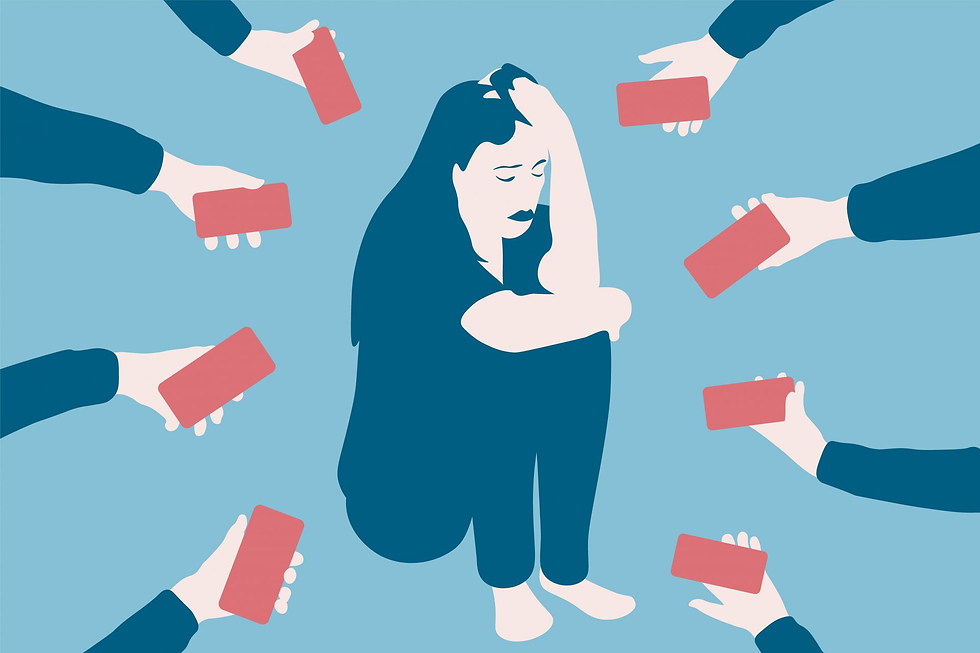
3000. Nothing more than four digits on a screen. Yet, that number represents how many teenagers take their own lives in the United States annually (“Addressing Pediatric Suicide”). Day after day. Minute after minute. In fact, the Yale School of Medicine cites suicide as being the second leading cause of death today amongst those aged 10-24 (Cornman). But why has suicide risen so dramatically in the last few years—what is the hidden culprit? The answer boils down to one simple statistic: Social media use doubles the likelihood of teens exhibiting suicidal behavior (Xiao and Meng). Social media is not the perfect online connector it is made out to be. Online bullying on platforms, as well as the amplification of harmful content on social media, all contribute to increased suicides amongst adolescents.
Bullying is not a new term. Even I have been bullied as a kid for little things like my hair. However, cyberbullying is a whole other issue, and today, it is the primary reason social media is such a catalyst for suicide amongst adolescents. It is no secret that most adolescents are already insecure and self-conscious, given that they are entering a new phase in their lives. Yet, when this is combined with online insults and mockery, it further amplifies their existing insecurities. In a study conducted by Dr. Ran Barzilay from the Children’s Hospital of Philadelphia, a group of adolescents participated in a longitudinal study for researchers to get a better understanding of child brain development. Most adolescents reported bullying and feeling left out, but one crucial finding was that “The participants who experienced cyberbullying were more than 4 times as likely to report thoughts of suicide and attempts as those who didn’t” (Reynolds). Nowadays, with teenagers constantly glued to their phones, practically omitting physical interactions, and thriving off the validation of strangers online, it isn’t shocking to see that suicide rates have spiked. In fact, a study conducted by Pew Research Center in 2025 shows that one in five teenagers report using platforms such as TikTok and YouTube almost constantly (Faverio and Sidoti). If cyberbullying is known to be a leading cause of suicidal thoughts and actions involving self-harm, and teens are now on social media more than ever, we cannot expect them to remain safe unless social media platforms are reformed. This can also be seen from various testimonies based on first-hand experiences. Jacqueline, for example, was a young high schooler at a friend’s party one night when she was filmed drunk without her consent. This humiliating video was then posted online, where it circulated through numerous social media platforms (“Real Stories”). What happened to Jacqueline was horrible; the way one post meant to harass her was able to be spread across social media in mere hours shows just how dangerous these sites are. Given this fact, while also knowing that such cyberbullying incidents are greatly linked to suicide, the twisted truth is apparent. Suicide and social media use are branches of the same vine.
But cyberbullying is not the only dark proponent of adolescent suicide. Social media platforms themselves promote harmful, scarring posts that drive teens into depression, followed by suicidal thoughts. I have seen this take effect myself. One of my friends was introduced to social media at a very young age and has since been using platforms such as TikTok and Snapchat regularly. She recently attempted suicide. It was one of the most horrifying turnarounds, as she always seemed so happy, so carefree. But she told us that at home, by herself, she would constantly scroll through TikTok, watch graphic videos, and slowly, she descended into a state of depression. This is not just one isolated case. There have been many who have suffered just like my friend. For example, The Guardian has an article regarding a London teenager, Molly Russell. She watched 138 social media videos containing self-harm and suicide, and saved 2,100 posts related to either suicide, self-harm, or depression. Soon after, she killed herself, and the last activity on her phone was a saved image with a slogan for depression on it (Milmo). What happened to Molly is a clear depiction of just how social media draws teenagers into its dark web of content. It starts with one liked post, then another, until the user’s entire feed is now filled with harmful content, promoted unchecked by these platforms. And there are multiple people out there who are coming to the same conclusion. In the current K.G.M. v. Meta et al. case, one of the women who was in attendance when Mark Zuckerberg testified in the Los Angeles Courthouse was Lori Schott, a mother who had lost her daughter to social media-driven suicide. According to CPR News, Schott said that her daughter’s feed was basically saying, “There's one way to take away the pain and here's a gun and bullets and you're never going to fit in” (Daley and Borden). Again and again, we see instances such as these, where teenagers are dying because social media algorithms are not built around positive messaging, but rather to push the user further into despair. Social media is not a place of connection, but of harmful content, preying on the most vulnerable.
However, critics argue that social media is only an amplifier of already existing underlying mental health issues among adolescents. They believe social media cannot organically create suicidal thoughts or ideas of self-harm. While it is true that suicide can be contributed to by multiple factors, pre-existing mental health conditions are not always necessary for social media to lead to suicidal ideation. For example, in a study of U.S. adolescents, published in the JAACAP Open Journal, teens were tracked over eight weeks as researchers examined their responses to self-harm content on social media. Researchers controlled for pre-existing mental health conditions, but still found that teens who reported seeing self-harm content were significantly more likely to experience urges to engage in self-injury than those who did not (Hamilton). This study clearly depicts how even short-term exposure to harmful social media content without underlying conditions can still significantly impact a teen’s mental state. Furthermore, mental health conditions don’t even have to be related for a teen to commit suicide due to social media. In the case of seventeen-year-old Ryan Last, the use of explicit images of himself as blackmail on a Meta platform led to his suicide (The Associated Press). This is yet another tragic story about an innocent teen who lost their life due to the dangers of social media. Therefore, it becomes clear that social media doesn’t just increase the risk of suicide, but has the potential to actually create it, making it all the more dangerous.
So let’s return to the number 3000, and remember that it represents sons, daughters, friends—all who took their own lives for several reasons. But let us also remember that someone among them might have taken their life because of a jeer made on Instagram. Someone might have harmed themself because a social media post convinced them to. Even if not every suicide in the United States stems directly from social media, numerous studies, cases, and testimonies have shown that it plays too big a role to be simply dismissed. Both cyberbullying, made easy by the structure of social media, and the harmful algorithm made to bolster disturbing content tamper with adolescents’ mental health and will to live. Like a drug, social media is addictive; like a drug, it can be deadly. We must stop teens from falling into the abyss that is social media; otherwise, they might not have the strength to return.
Works Cited
The Associated Press. “Four men arrested in West Africa for extortion scheme linked to California teen's suicide.” AP News, 2025, https://apnews.com/article/california-teen-suicide-sextortion-cote-divoire-9dbf8d40c7784dc6843e3ce7b910ca07. Accessed 22 February 2026.
Children's Hospital Association. “Addressing Pediatric Suicide.” Children's Hospital Association, 2025, https://www.childrenshospitals.org/content/behavioral-health/summary/the-state-of-pediatric-suicide. Accessed 22 February 2026.
Cornman, Eva. “Youth Suicide Is on the Rise: Yale Aims to Save Lives.” Yale School of Medicine, 11 September 2024, https://medicine.yale.edu/news-article/youth-suicide-is-on-the-rise-yale-aims-to-save-lives/. Accessed 22 February 2026.
Daley, John, and Alison Borden. “Colorado woman whose daughter died attends social media trial as addiction lawsuit plays out.” Colorado Public Radio, 19 February 2026, https://www.cpr.org/2026/02/19/social-media-addiction-suicide-lawsuit-annalee-schott/. Accessed 22 February 2026.
eSafety Commissioner. “Real stories.” eSafety Commissioner, 4 December 2025, https://www.esafety.gov.au/key-topics/cyberbullying/stories. Accessed 22 February 2026.
Faverio, Michelle, and Olivia Sidoti. “Teens, Social Media and AI Chatbots 2025.” Pew Research Center, 9 December 2025, https://www.pewresearch.org/internet/2025/12/09/teens-social-media-and-ai-chatbots-2025/. Accessed 22 February 2026.
Hamilton, Jessica L. “Self-Harm Content on Social Media and Proximal Risk for Self-Injurious Thoughts and Behaviors Among Adolescents.” JAACAP Open, 2025, https://pubmed.ncbi.nlm.nih.gov/40922781/. Accessed 22 February 2026.
Milmo, Dan. “'The bleakest of worlds': how Molly Russell fell into a vortex of despair on social media.” The Guardian, 30 September 2022, https://www.theguardian.com/technology/2022/sep/30/how-molly-russell-fell-into-a-vortex-of-despair-on-social-media. Accessed 22 February 2026.
Reynolds, Sharon. “Cyberbullying linked with suicidal thoughts and attempts in young adolescents.” NIH, 12 July 2022, https://www.nih.gov/news-events/nih-research-matters/cyberbullying-linked-suicidal-thoughts-attempts-young-adolescents. Accessed 22 February 2026.
Xiao, Yunyu, and Yuan Meng. “Addictive Screen Use Trajectories and Suicidal Behaviors, Suicidal Ideation, and Mental Health in US Youths.” JAMA, 2025, https://pubmed.ncbi.nlm.nih.gov/40531519/. Accessed 22 February 2026.



Comments